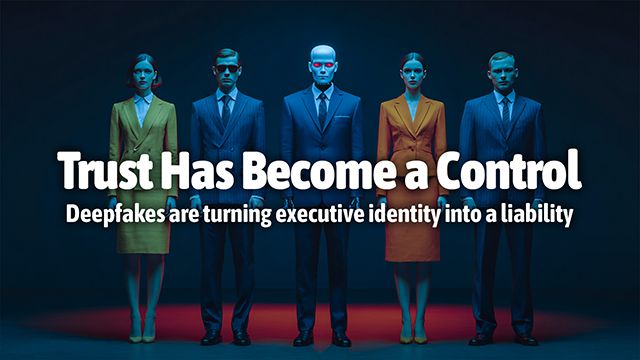

Trust Has Become a Control - Deepfakes are turning executive identity into a liability
Sources
For years, corporate America treated trust like free infrastructure. It sat quietly underneath everything. A familiar voice on a call. A recognizable face in a meeting. A message that appeared to come from someone senior enough to bypass friction. Entire organizations ran on these signals because they were efficient, socially reinforced, and rarely questioned. That model now has a price tag.
The latest warnings on deepfake fraud make the point brutally clear. Synthetic impersonation is no longer an entertaining corner of internet absurdity, nor a reputational nuisance reserved for public figures and bad headlines. It is becoming a direct attack on how companies authorize payments, handle urgency, validate decisions, and communicate under pressure. Fortune’s March 3 report put a hard number on that shift, describing an estimated $1.1 billion drained from U.S. corporate accounts in 2025, up sharply from the year before, while arguing that most boards and communications teams are still structurally unprepared for what comes next.
That number matters, but the larger issue is even more important. Deepfakes do not simply create fake content. They destabilize the assumption that authority can be recognized in real time. Once that assumption fails, every function that depends on executive identity starts to wobble. Treasury becomes easier to manipulate. Legal exposure increases. Crisis communications becomes harder. Audit trails get uglier. Board oversight starts looking suspiciously ceremonial.
This is no longer a story about fake videos. It is a story about what happens when institutions discover that authenticity was one of their least-governed dependencies.
The fraud is not the whole problem
Most conversations about deepfakes still begin in the wrong place. They begin with the artifact. The voice clone. The altered video. The fabricated statement. The piece of media is treated as the event, which encourages leaders to imagine the problem as one of detection. Spot the fake, expose the scam, move on. That is a convenient fantasy, and like most convenient fantasies in governance, it is expensive.
The real event happens earlier. It happens when a person inside the organization decides to act because something sounds plausible enough, urgent enough, and senior enough to override hesitation. Deepfake fraud works because it exploits institutional habits that long predate generative AI. Hierarchy, deference, speed, and fear of being the person who slows down an executive request have always been exploitable. Synthetic media simply scales those weaknesses.
This is why boards that treat deepfakes as a cyber subcategory are already behind. The threat is not confined to malware, phishing, or platform security. It touches any process that still assumes recognition is a valid substitute for verification.
If your treasury team can still be moved by the sound of a familiar voice, your control environment is weaker than your policy deck suggests. If your communications team still has no pre-cleared protocol for a fake executive statement moving at social-media speed, your crisis readiness is mostly decorative. If your legal team still treats synthetic impersonation as a hypothetical instead of a foreseeable control failure, your discovery process may eventually become educational.
The boardroom blind spot
Boards like AI when it arrives as growth. They like it in product demos, margin stories, automation forecasts, and investor narratives about efficiency. They like it less when the same underlying technology shows up as a tool for impersonation, fraud, and evidentiary confusion. The usual response is to send the problem downhill. Let security “look into it.” Let communications “prepare messaging.” Let legal “monitor developments.” Let someone else own the thing that crosses too many organizational boundaries to fit into a neat committee update.
That is the blind spot. Deepfakes are a governance problem precisely because they do not stay in one lane.
The Fortune argument is useful here because it frames the issue in operational terms boards understand when they are willing to be honest: disclosure obligations, coordination failures, and sequencing across legal, cybersecurity, investor relations, and communications. A synthetic-media incident is not one crisis. It is several crises arriving at once, each with a different clock and a different consequence if mishandled.
That means a board asking whether management is “aware” of deepfakes is asking the wrong question. Awareness is cheap. So are panels, keynotes, and executive summaries. The serious questions are more uncomfortable.
Which actions inside this company still depend on a single signal of executive authenticity. Which high-risk approvals can still be accelerated by urgency. Which teams are authorized to publicly authenticate leadership communications in minutes, not days. Which external counterparties know how this company verifies sensitive requests. Which directors have actually walked through a synthetic-media scenario instead of merely nodding at the phrase “emerging risk.”
If those answers are vague, then the board is not governing the risk. It is admiring it from a safe distance.
Why audit and legal should already care
Deepfake fraud is maturing into the kind of risk that changes legal posture before many executives realize it. That is because the standard is shifting from surprise to foreseeability. Once regulators, financial-crime authorities, and law enforcement agencies begin issuing specific alerts, the defense of “we could not reasonably anticipate this” gets harder to maintain. FinCEN did not treat deepfake-enabled fraud as science fiction in its 2024 alert. It treated it as a present and growing threat to financial institutions, complete with typologies and red flags.
That matters. It means any company still relying on easily spoofed signals for sensitive actions is choosing to keep vulnerable processes in place after formal warnings already exist. In legal terms, that is not just unfortunate timing. It begins to look like control design that failed to evolve with the threat landscape.
Auditors should care because this creates a familiar and deeply unpleasant pattern. The policy may say one thing. The actual operational behavior may say another. On paper, approvals require discipline. In practice, the urgent executive request still moves faster than the documented control. That gap is exactly where deepfake-enabled losses become both financially painful and painfully explainable.
Internal audit teams that ignore this are likely to discover, after an incident, that the real weakness was not an absence of policy. It was an excess of exceptions, workarounds, and cultural assumptions that nobody wanted to test because testing them would have been awkward. Deepfake fraud thrives in awkwardness. It depends on the organization preferring speed, politeness, and hierarchy over explicit verification.
Litigators, of course, will eventually describe that in more expensive language.
The collapse of informal authority
The most disruptive part of this shift is not technical. It is cultural.
Modern companies have been optimized around velocity, and velocity depends on shortcuts. One of the biggest shortcuts is informal authority. The right person speaks, and friction disappears. That is efficient when identity is hard to fake. It becomes reckless when identity can be simulated well enough to trigger action.
The problem is that most organizations still reward obedience more consistently than skepticism. Employees are trained to escalate, align, move quickly, and not become bottlenecks. Very few are trained to treat executive urgency as a potential attack vector. Even fewer are socially protected when they challenge it.
So the company creates a perfect environment for synthetic fraud. The technology provides the imitation. The hierarchy provides the pressure. The culture provides the compliance.
This is why deepfake defense cannot be reduced to awareness training. Awareness tells employees that fake media exists. It does not redesign the incentives that make people override their own doubts when the fake appears to come from someone powerful. If leadership wants a serious response, it has to do something many companies still find emotionally offensive: make verification mandatory even when it slows down senior people.
That is not disrespect. That is adulthood.
The communications function is now part of the control environment
Many companies still treat communications as the team that shows up after the incident, wearing calm language and fresh coffee. That model is obsolete in a synthetic-media environment.
A fake executive statement, manipulated video, or cloned voice message can create operational, reputational, and market consequences before the company has fully established what happened. By the time legal has reviewed language, security has confirmed the artifact, and leadership has aligned on messaging, the fake may already have become the first draft of reality for employees, customers, journalists, investors, and counterparties.
This changes the role of communications from reactive storyteller to active control participant. The company now needs predetermined methods to authenticate legitimate executive communications quickly, publicly, and across channels. It needs internal and external escalation trees. It needs known authority to respond fast without waiting for fifteen layers of corporate throat-clearing. And it needs rehearsal, because synthetic-media crises are exactly the kind of event where the first thirty minutes are usually controlled by whoever prepared before anyone else felt comfortable doing so.
Fortune’s emphasis on disclosure protocols, tabletop exercises, and coordinated responses is not cosmetic advice. It is governance advice disguised as communications advice.
The teams that still think this is just “PR” are preparing for yesterday’s emergency.
Public-sector warnings should scare the private sector more
One of the more revealing developments in the last year is that official warnings have become more specific, more frequent, and less theoretical.
In late 2024, FinCEN flagged deepfake-media fraud aimed at financial institutions. In 2025, the FBI and IC3 warned about malicious actors using AI-generated voice and text messages to impersonate senior U.S. officials. In late 2025, the FBI expanded that warning, noting impersonation activity tied to senior state officials, White House figures, Cabinet-level officials, and members of Congress, with activity dating back to 2023.
That matters for corporate leaders because public-sector impersonation campaigns are often a preview of what will scale more broadly. Attackers test what works where stakes are high and verification habits are inconsistent. If senior officials can be impersonated convincingly enough to trigger formal warnings, then there is no rational basis for assuming your C-suite is somehow less usable as attack material.
The UK government’s February 2026 figures add another uncomfortable layer. It said shared deepfakes rose from 500,000 in 2023 to 8,000,000 in 2025 and tied that growth directly to rising fraud concerns and the need for clearer detection standards.
The scale here matters because volume changes the economics of trust. As synthetic media becomes cheaper to produce and easier to distribute, organizations cannot treat each fake as an exceptional event. They need operating assumptions for a world where attempts are frequent, some are crude, some are convincing, and a few will arrive at exactly the wrong moment with exactly the right amount of plausibility.
That is not an anomaly. That is the new environment.
What a serious control response looks like
There is no software purchase that solves this on its own, and that is exactly why many companies will mishandle it. Detection matters, yes. Monitoring matters. Forensics matter. Vendor evaluation matters. But the core defense is not merely technical. It is procedural. The organizations that take this seriously will redesign the conditions under which a fake can cause harm.
They will remove single-point authority from high-risk actions. They will require out-of-band verification for sensitive requests, especially where money, data, credentials, or market-moving communications are involved. They will define which channels are never sufficient on their own. They will establish fast-response authentication paths for executive communications. They will make sure treasury, legal, security, communications, compliance, and the board are not each inventing separate theories of the same risk.
Most importantly, they will make verification culturally legitimate. That sounds obvious until you remember how many organizations still quietly punish the person who asks, “Can we confirm this another way?” at the wrong time, to the wrong superior, in the middle of a supposedly urgent request.
If leadership wants deepfake resilience, it needs to stop romanticizing speed and start respecting friction. The right kind of friction is not bureaucracy. It is what prevents expensive stupidity from masquerading as trust.
The liability of still pretending this is tomorrow’s problem
The most dangerous corporate response to deepfakes now is not panic. It is polite underreaction.
It is the leadership team that says the right things, commissions a briefing, adds the risk to a watchlist, and then leaves the underlying workflow untouched. It is the board that approves AI strategy but never asks how AI changes executive authentication. It is the company that assumes reputational resilience can compensate for procedural weakness. It is the legal department that waits for precedent while the threat model is already moving. That posture used to be survivable. It is becoming less so.
Once a risk is visible, discussed, and increasingly documented by regulators, law enforcement, and major institutions, inaction becomes harder to defend as prudence. It begins to look like avoidance. And avoidance, in governance, has a nasty habit of reappearing later as liability.
Deepfakes are not just creating new fraud pathways. They are forcing a reassessment of what a “reasonable” control environment looks like in an age when human identity signals can be synthesized cheaply and deployed fast. Companies that absorb that lesson now will still have problems, but at least they will have a framework.
Companies that delay will keep discovering that what they called trust was often just an undocumented exception process with good lighting.
The new rule
For a long time, leadership presence accelerated action. Now leadership likeness can accelerate fraud.
That single reversal explains why this issue belongs in the boardroom, in the audit plan, in the crisis playbook, and in the control framework. Not because synthetic media is flashy. Not because deepfakes make for dramatic headlines. But because they expose an old institutional weakness that many companies never properly governed in the first place: the tendency to treat authority as proof. That era is over.
The face on the screen is no longer evidence. The voice on the call is no longer assurance. The urgent request from someone important is no longer a reason to reduce friction. In a synthetic-media environment, trust still matters, but it cannot remain informal, instinctive, and free. It has to become a designed control.
That is the real shift. And it will separate the companies that modernize their operating assumptions from the ones that keep learning, one fake voice at a time, that “believable enough” is all an attacker ever needed.